Robert to Elizabeth, April 10, 1846
[On making up from a disagreement. Elizabeth had taken issue with an opinion of Robert's on duelling. At first he defended himself. She feared her disagreements with him would make him not love her anymore. But then he surrendered, admitting she was right, and then reassuring her that he was not about to stop loving her.]
My election is made or God made it for me,--and is irrevocable. I am wholly yours. I see you have yet to understand what that implies,--but you will one day. . . . What are you given me for but to make me better--and, in that, happier? If you could save my soul, 'so as by fire,' would your dear love shrink from that? But in the matter we really refer to . . . Oh, Ba, did I not pray you at the beginning to tell me the instand you detected anything to be altered by human effort? to give me that chance of becoming more like you and worthier of you? and here where you think me gravely in the wrong, -- one or two repetitions of such conduct of yours, such 'disagreeable letters,' and I must 'leave off' . . .
Can you, now, by this time tell me or yourself that you could believe me happy with any other woman that ever breathed? I tell you, without affectation, that I lay the whole blame to myself . . . that I feel that if I had spoken my love out sufficiently, all this doubt could never have been possible. . . .
May God bless you, dearest -- and show you the truth in me, the one truth which I dare hope compensates for much that is to be forgiven: when I told you at the beginning I was not worthy, was infinitely lower &c, you seemed incredulous! well now, you see! I, that you would persist in hoping better things of, held such opinions as those -- and so I am set far on towards right -- is not all well, love? And now go on, when I give next occasion, and tell me more, and let me alter more, and thank you, if I can, more, -- but not, not love you more, you, Ba, whom I love wholly, -- with all my faculties, all my being. May God bless you, again -- it all ends there -- !
Elizabeth's answer, April 13, 1846
I will not speak much of the letter, as you desire that I should not. . . . Let me say only then, ever dearest, dearest, that I never felt towards you as I felt when I had read that letter . . never loved you so entirely! . . that it went to my heart, and stayed there, and seemed to mix with the blood of it . . . believe this of me, dear dearest beloved! For the rest, there is no need for me to put aside carefully the assumption of being didactic to you . . of being better than you, so as to teach you! . . . ah, you are so fond of dressing me up in pontifical garments ('for fun,' as the children say!) -- but because they are too large for me, they drop off always of themselves, . . they do not require my pulling them off: these extravagances get righted of their own accord. After all, too, you, . . with that praeternatural submissiveness of yours, . . you know your power upon the whole, and understand, in the midst of the obeisances, that you can do very much what you please, with your High Priest. . . .
And now, do you see. It was just natural that when we differed for the first time I should fall into low spirits. In the night, at dream-time, when instead of dreams 'deep thought falleth upon man,' suddenly I have been sad even to tears, do you know, to think of that: and whenever I am not glad, the old fears and misgivings come back -- no, you do not understand . . you cannot, perhaps! But dear, dearest, never think of yourself that you have expressed 'insufficiently' your feelings for me. Insufficiently! No words but just your own, between heaven and earth, could have persuaded me that such a one as you could love me! and the tongue of angels could not speak better words for that purpose, than just yours. Also, I know that you love me . . I do know it, my only dearest, and recognize it in the gratitude of my soul: -- and it is through my want of familiarity with any happiness -- through the want of use in carrying these weights of flowers, that I drop them again and again out of weak hands. Besides the truth is, that I am not worthy of you -- and if you were to see it just as I see it, why there would be an end . . there, . . I sometimes think reasonably.
* * *
As promised, I copied out some of their letters. I feel a little funny reading someone else's love letters, but I don't suppose they'd mind, being (I think and hope) in Heaven. These are beautiful letters. They are an amazing couple. I'm afraid they'll lure me away from my plans to write my senior thesis on the Arthurian legends, and draw me into a thesis about them. But however much I enjoy their story and their words, I don't think I'll give in.
Lovers' quarrels are supposed to be common things, but the Brownings' version is quite different from what you'd think. They each give their opinions on the subject, and find, much to their dismay, that they differ. They answer each other's arguments. Then they suddenly realize that their love for each other is so much more important than the subject of debate, and they drop the disagreement and just go back to complimenting each other (which is what they spend most of their letters doing). If all couples quarrelled like that, divorce lawyers would be out of business.
*Note on the text: most of the ellipses are not mine, but theirs. I didn't distinguish mine from theirs. The italics and dashes and spellings, &c, are all theirs.
Friday, January 20, 2006

Tuesday, January 17, 2006
Sonnets from the Portuguese: XLIII
by Elizabeth Barrett Browning
How do I love thee? Let me count the ways.
I love thee to the depth and breadth and height
My soul can reach, when feeling out of sight
For the ends of Being and ideal Grace.
I love thee to the level of everyday's
Most quiet need, by sun and candle-light.
I love thee freely, as men strive for Right;
I love thee with the passion put to use
In my old griefs, and with my childhood's faith.
I love thee with a love I seemed to lose
With my lost saints,--I love thee with the breath,
Smiles, tears, of all my life!--and, if God choose,
I shall but love thee better after death.
* * *
Time for another Browning sonnet! This one's probably the most famous, although no one can seem to get past the first line.
First, she talks about how big her love is -- the breadth and depth and height of her soul. Next, how small it is -- it fits in gently with the everday things. She loves him with all the strength of every virtue -- justice, long-suffering, faith. She remembers her "lost saints" -- probably her mother and brother, whose deaths saddened her greatly -- and find that she loves him the same way. All her life is love for him -- and so will the next life be.
The voice of the modern world is plainer, but says the same: "This is true love -- you think this happens every day?" True love is beyond everything -- because all true love is of God.
I've been reading the Brownings' letters to each other lately. They are very beautiful. I'll have to copy out some bits later on.
How do I love thee? Let me count the ways.
I love thee to the depth and breadth and height
My soul can reach, when feeling out of sight
For the ends of Being and ideal Grace.
I love thee to the level of everyday's
Most quiet need, by sun and candle-light.
I love thee freely, as men strive for Right;
I love thee with the passion put to use
In my old griefs, and with my childhood's faith.
I love thee with a love I seemed to lose
With my lost saints,--I love thee with the breath,
Smiles, tears, of all my life!--and, if God choose,
I shall but love thee better after death.
* * *
Time for another Browning sonnet! This one's probably the most famous, although no one can seem to get past the first line.
First, she talks about how big her love is -- the breadth and depth and height of her soul. Next, how small it is -- it fits in gently with the everday things. She loves him with all the strength of every virtue -- justice, long-suffering, faith. She remembers her "lost saints" -- probably her mother and brother, whose deaths saddened her greatly -- and find that she loves him the same way. All her life is love for him -- and so will the next life be.
The voice of the modern world is plainer, but says the same: "This is true love -- you think this happens every day?" True love is beyond everything -- because all true love is of God.
I've been reading the Brownings' letters to each other lately. They are very beautiful. I'll have to copy out some bits later on.
Friday, January 13, 2006
Wine and Water
by G.K. Chesterton
Old Noah he had an ostrich farm and fowls on the largest scale,
He ate his egg with a ladle in an egg-cup big as a pail,
And the soup he took was Elephant Soup and the fist he took was Whale,
But they all were small to the cellar he took when he set out to sail
And Noah he often said to his wife when he sat down to dine,
"I don't care where the water goes if it doesn't get into the wine."
The cataract of the cliff of heaven fell blinding off the brink
As if it would wash the stars away as suds go down a sink,
The seven heavens came roaring down for the throats of hell to drink,
And Noah he cocked his eye and said, "It looks like rain, I think,
The water has drowned the Matterhorn as deep as a Mendip mine,
But I don't care where the water goes if it doesn't get into the wine."
But Noah he sinned, and we have sinned, on tipsy feet we trod,
Till a great big black teetotaller was sent to us for a rod,
And you can't get wine at a P.S.A., or chapel, or Eisteddfod,
For the Curse of Water has come again because of the wrath of God,
And water is on the Bishop's board and the Higher Thinker's shrine,
But I don't care where the water goes if it doesn't get into the wine.
* * *
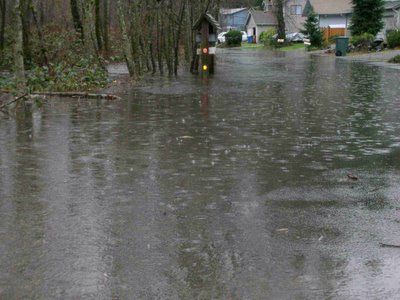
This poem is in honour of what I believe is our 26th day of rain here in the Seattle area. Our street, which is here pictured, is under a foot of water in some places. All of what appears to be a lake is actually paved. Behind the mailbox a few feet is our drainage ditch, which is several feet deep but which nonetheless overflowed. Behind that is a marshy area, usually, which currently is a lake several feet deep. I don't know how deep it is exactly, because I don't have a good boat in which to go measure, but I know the marsh grass is two to three feet high and it's all covered.
We're still able to get in and out, although I'm sure it's not good for our car. The mailman has stopped delivering, though, since it's at least a foot at the mailbox. (I know; I waded out barefoot once to check the mail. Brr! Fresh rainwater in January is pretty chilly!) We've been flooded like this for three days or so, and much looking forward to some recession of the water. But the prognosis is for more rain for awhile. We're working on breaking a record for the most consecutive days raining.
Of course, Chesterton was talking about wine more than about water. The sin of Noah referred to is the sin of drunkenness: Noah was the first to grow grapes and make wine, and he made himself drunk and lay uncovered in his tent. It's fairly early on in Genesis. G.K.C's point is that when drinkers become drunk, they lose the privilege of being able to drink at all. Prohibitionists become necessary to make us drink water when we have forgotten how to drink wine with moderation. Chesterton was all for drinking, but this is proof he was not for drunkenness.
The poem is taken from The Flying Inn, a book worth reading, so long as you've already read The Ball and the Cross and The Napoleon of Notting Hill. Of course, if you haven't read those already you're anathema anyway. Go read them.
Old Noah he had an ostrich farm and fowls on the largest scale,
He ate his egg with a ladle in an egg-cup big as a pail,
And the soup he took was Elephant Soup and the fist he took was Whale,
But they all were small to the cellar he took when he set out to sail
And Noah he often said to his wife when he sat down to dine,
"I don't care where the water goes if it doesn't get into the wine."
The cataract of the cliff of heaven fell blinding off the brink
As if it would wash the stars away as suds go down a sink,
The seven heavens came roaring down for the throats of hell to drink,
And Noah he cocked his eye and said, "It looks like rain, I think,
The water has drowned the Matterhorn as deep as a Mendip mine,
But I don't care where the water goes if it doesn't get into the wine."
But Noah he sinned, and we have sinned, on tipsy feet we trod,
Till a great big black teetotaller was sent to us for a rod,
And you can't get wine at a P.S.A., or chapel, or Eisteddfod,
For the Curse of Water has come again because of the wrath of God,
And water is on the Bishop's board and the Higher Thinker's shrine,
But I don't care where the water goes if it doesn't get into the wine.
* * *
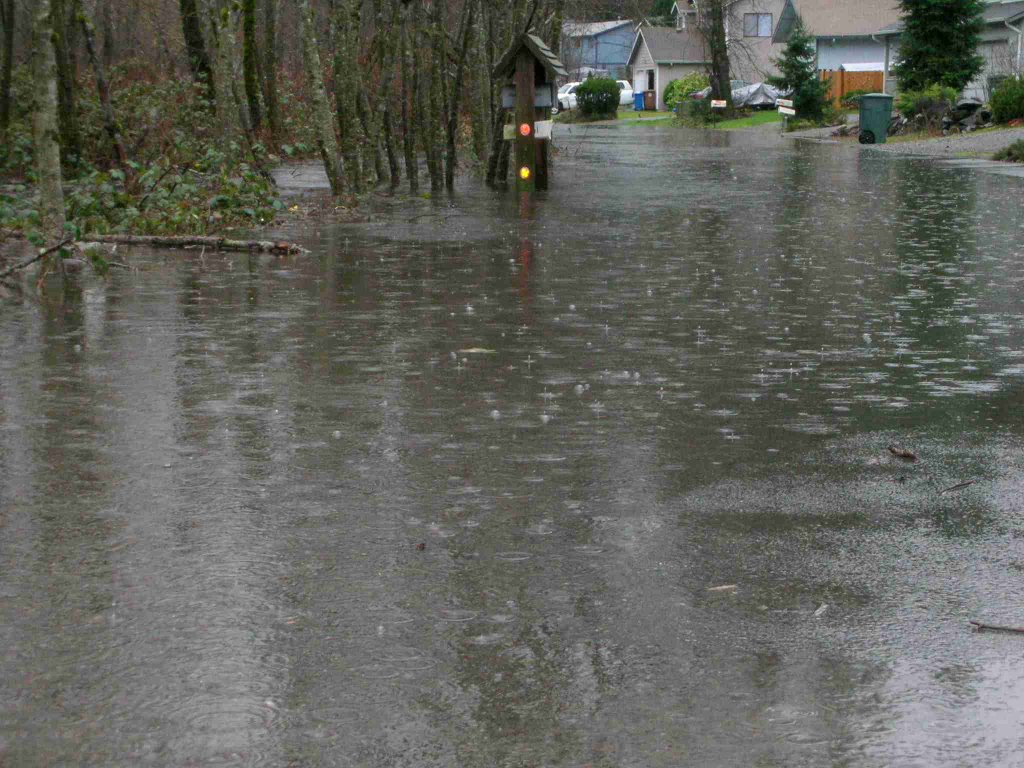
This poem is in honour of what I believe is our 26th day of rain here in the Seattle area. Our street, which is here pictured, is under a foot of water in some places. All of what appears to be a lake is actually paved. Behind the mailbox a few feet is our drainage ditch, which is several feet deep but which nonetheless overflowed. Behind that is a marshy area, usually, which currently is a lake several feet deep. I don't know how deep it is exactly, because I don't have a good boat in which to go measure, but I know the marsh grass is two to three feet high and it's all covered.
We're still able to get in and out, although I'm sure it's not good for our car. The mailman has stopped delivering, though, since it's at least a foot at the mailbox. (I know; I waded out barefoot once to check the mail. Brr! Fresh rainwater in January is pretty chilly!) We've been flooded like this for three days or so, and much looking forward to some recession of the water. But the prognosis is for more rain for awhile. We're working on breaking a record for the most consecutive days raining.
Of course, Chesterton was talking about wine more than about water. The sin of Noah referred to is the sin of drunkenness: Noah was the first to grow grapes and make wine, and he made himself drunk and lay uncovered in his tent. It's fairly early on in Genesis. G.K.C's point is that when drinkers become drunk, they lose the privilege of being able to drink at all. Prohibitionists become necessary to make us drink water when we have forgotten how to drink wine with moderation. Chesterton was all for drinking, but this is proof he was not for drunkenness.
The poem is taken from The Flying Inn, a book worth reading, so long as you've already read The Ball and the Cross and The Napoleon of Notting Hill. Of course, if you haven't read those already you're anathema anyway. Go read them.
Tuesday, January 03, 2006
Jesu Dulcis Memoria
Jesu dulcis memoria
Dans vera cordis gaudia:
Sed super mel et omnia
Ejus dulcis praesentia.
Jesus, sweet remembrance
Giving true joy of hearts:
But above honey and all things
Is his sweet presence.
Nil canitur suavius,
Nil auditur jucundius
Nil cogitatur dulcius
Quam Jesus Dei filius.
Nothing more pleasing is sung,
Nothing more joyful is heard,
Nothing more sweet is thought,
Than Jesus the son of God.
Jesu spes penitentibus,
Quam pius es petentibus!
Quam bonus te quaerentibus!
Sed quid invenientibus?
Jesus, hope of the penitent,
How merciful you are to those who seek!
How good to those who ask you!
But what to those who find?
Nec lingua valet dicere,
Nec littera exprimere:
Expertus potest credere,
Quid sit Jesum diligere.
The tongue does not have power to say,
Nor writing to express:
Experience can believe
What it is to love Jesus.
Sis Jesu nostrum gaudium
Qui es futurus praemium
Sit nostra in te gloria
Per cuncta semper saecula. Amen.
Jesus, may you be our joy,
Who are our future reward;
Let glory be ours in you
Always, through all ages. Amen.
* * *
The translation is mostly mine, with a little help from Wikipedia. (Yes, I know, I'm getting addicted to posting translations. They're so much fun! Do read the Latin, though, even if you don't understand it: it's wonderfully poetic, and I couldn't convey that at all without messing unpardonably with the meaning.) I'm posting this in honour of the feast of the Holy Name of Jesus, which I think was yesterday.
As a complement to it, I'm including this other text on the subject of the power of names, this one from The Lion, the Witch, and the Wardrobe. (I saw the movie over the weekend and liked it. But this is from the book.)
* * *
'They say Aslan is on the move -- perhaps has already landed.'
And now a very curious thing happened. None of the children knew who Aslan was any more than you do; but the moment the Beaver had spoken these words everyone felt quite different. Perhaps it has sometimes happened to you in a dream that someone says something which you don't understand but in the dream it feels as if it had some meaning -- either a terrifying one which turns the whole dream into a nightmare or else a lovely meaning too lovely to put into words, which makes the dream so beautiful that you remember it all your life and are always wishing you could get back into that dream again. It was like that now. At the name of Aslan each one of the children felt something jump in its inside. Edmund felt a sensation of mysterious horror. Peter felt suddenly very brave and adventurous. Susan felt as if some delicious smell or some delightful strain of music had just floated by her. And Lucy got the feeling you have when you wake up in the morning and realize that it is the beginning of the holidays or the beginning of summer.
* * *
It takes a very powerful person to have his power overflow into his name, so that the name itself has a power of its own. Yet this is the case with the Holy Name of Jesus: "a name above any other name."
Dans vera cordis gaudia:
Sed super mel et omnia
Ejus dulcis praesentia.
Jesus, sweet remembrance
Giving true joy of hearts:
But above honey and all things
Is his sweet presence.
Nil canitur suavius,
Nil auditur jucundius
Nil cogitatur dulcius
Quam Jesus Dei filius.
Nothing more pleasing is sung,
Nothing more joyful is heard,
Nothing more sweet is thought,
Than Jesus the son of God.
Jesu spes penitentibus,
Quam pius es petentibus!
Quam bonus te quaerentibus!
Sed quid invenientibus?
Jesus, hope of the penitent,
How merciful you are to those who seek!
How good to those who ask you!
But what to those who find?
Nec lingua valet dicere,
Nec littera exprimere:
Expertus potest credere,
Quid sit Jesum diligere.
The tongue does not have power to say,
Nor writing to express:
Experience can believe
What it is to love Jesus.
Sis Jesu nostrum gaudium
Qui es futurus praemium
Sit nostra in te gloria
Per cuncta semper saecula. Amen.
Jesus, may you be our joy,
Who are our future reward;
Let glory be ours in you
Always, through all ages. Amen.
* * *
The translation is mostly mine, with a little help from Wikipedia. (Yes, I know, I'm getting addicted to posting translations. They're so much fun! Do read the Latin, though, even if you don't understand it: it's wonderfully poetic, and I couldn't convey that at all without messing unpardonably with the meaning.) I'm posting this in honour of the feast of the Holy Name of Jesus, which I think was yesterday.
As a complement to it, I'm including this other text on the subject of the power of names, this one from The Lion, the Witch, and the Wardrobe. (I saw the movie over the weekend and liked it. But this is from the book.)
* * *
'They say Aslan is on the move -- perhaps has already landed.'
And now a very curious thing happened. None of the children knew who Aslan was any more than you do; but the moment the Beaver had spoken these words everyone felt quite different. Perhaps it has sometimes happened to you in a dream that someone says something which you don't understand but in the dream it feels as if it had some meaning -- either a terrifying one which turns the whole dream into a nightmare or else a lovely meaning too lovely to put into words, which makes the dream so beautiful that you remember it all your life and are always wishing you could get back into that dream again. It was like that now. At the name of Aslan each one of the children felt something jump in its inside. Edmund felt a sensation of mysterious horror. Peter felt suddenly very brave and adventurous. Susan felt as if some delicious smell or some delightful strain of music had just floated by her. And Lucy got the feeling you have when you wake up in the morning and realize that it is the beginning of the holidays or the beginning of summer.
* * *
It takes a very powerful person to have his power overflow into his name, so that the name itself has a power of its own. Yet this is the case with the Holy Name of Jesus: "a name above any other name."
Thursday, December 29, 2005
Cantico espiritual
by St. John of the Cross
¿Adónde te escondiste,
amado, y me dejaste con gemido?
Como el ciervo huiste,
habiéndome herido;
salí tras ti, clamando, y eras ido.
Where have you hidden yourself,
beloved, and left me with groaning?
You have fled like the deer,
having wounded me;
I went out after you, crying out, and you had gone.
Pastores, los que fuerdes
allá, por las majadas, al otero,
si por ventura vierdes
aquél que yo más quiero,
decidle que adolezco, peno y muero.
Shepherds, you who go
up there, through the sheepfolds, to the hill,
if you perhaps see
him whom I love most,
tell him that I grow sick, suffer and die.
Buscando mis amores,
iré por esos montes y riberas;
ni cogeré las flores,
ni temeré las fieras,
y pasaré los fuertes y fronteras.
Seeking my loves,
I will go through these mountains and riverbanks;
I will not collect the flowers,
I will not fear the wild animals,
and I will pass the strong (men) and the frontiers.
. . . . . . . . . . . . . . . . . . . . . . . . . .
¿Por qué, pues has llagado
aqueste corazón, no le sanaste?
Y pues me le has robado,
¿por qué así le dejaste,
y no tomas el robo que robaste?
Why, since you have wounded
this heart, have you not healed it?
And since you have robbed me of it,
why do you leave me so,
and not take the robbery that you have robbed?
Apaga mis enojos,
pues que ninguno basta a deshacellos,
y véante mis ojos,
pues eres lumbre dellos,
y sólo para ti quiero tenellos.
Quench my angers,
for no one else can extinguish them,
and may my eyes see you,
for you are the light of them,
and I want to keep them only for you.
¡Oh cristalina fuente,
si en esos tus semblantes plateados,
formases de repente
los ojos deseados,
que tengo en mis entrañas dibujados!
O crystal fountain,
if in your silvered surfaces,
you would form suddenly
the desired eyes,
that I have drawn on my heart!
* * *
The translation is my own, with a little help. There were about a half dozen words that don't show up in my little pocket dictionary. Most of it, however, is quite literally translated.
I am very fond of this poem. Of course, the Song of Songs has always been a favorite of mine, but I think St. John brings something of his own to the story. He enhances the search of the bride for her lover with his own experience of searching for Christ.
The poem begins with the bride's search. She looks everywhere, asks everyone for some word of her lover. In the same way, when seeking Christ, it is natural and good for us to look everywhere and ask everyone: Have you seen Him whom my heart loves?
The second part I translated is part of the bride's prayer to her lover. She begins to be impatient for some sign of the lover. Where is he? She begs him to come to her. This is the other part of our search for Christ: asking Him directly.
"Oh cristalina fuente" is an address to someone else again. I have heard the phrase "crystal fountain of faith" as a title for Mary. Perhaps the symbol here is of the soul asking Mary to form Christ again, not in her womb this time, but in the soul. The soul possesses His image, but is still searching for His reality.
¿Adónde te escondiste,
amado, y me dejaste con gemido?
Como el ciervo huiste,
habiéndome herido;
salí tras ti, clamando, y eras ido.
Where have you hidden yourself,
beloved, and left me with groaning?
You have fled like the deer,
having wounded me;
I went out after you, crying out, and you had gone.
Pastores, los que fuerdes
allá, por las majadas, al otero,
si por ventura vierdes
aquél que yo más quiero,
decidle que adolezco, peno y muero.
Shepherds, you who go
up there, through the sheepfolds, to the hill,
if you perhaps see
him whom I love most,
tell him that I grow sick, suffer and die.
Buscando mis amores,
iré por esos montes y riberas;
ni cogeré las flores,
ni temeré las fieras,
y pasaré los fuertes y fronteras.
Seeking my loves,
I will go through these mountains and riverbanks;
I will not collect the flowers,
I will not fear the wild animals,
and I will pass the strong (men) and the frontiers.
. . . . . . . . . . . . . . . . . . . . . . . . . .
¿Por qué, pues has llagado
aqueste corazón, no le sanaste?
Y pues me le has robado,
¿por qué así le dejaste,
y no tomas el robo que robaste?
Why, since you have wounded
this heart, have you not healed it?
And since you have robbed me of it,
why do you leave me so,
and not take the robbery that you have robbed?
Apaga mis enojos,
pues que ninguno basta a deshacellos,
y véante mis ojos,
pues eres lumbre dellos,
y sólo para ti quiero tenellos.
Quench my angers,
for no one else can extinguish them,
and may my eyes see you,
for you are the light of them,
and I want to keep them only for you.
¡Oh cristalina fuente,
si en esos tus semblantes plateados,
formases de repente
los ojos deseados,
que tengo en mis entrañas dibujados!
O crystal fountain,
if in your silvered surfaces,
you would form suddenly
the desired eyes,
that I have drawn on my heart!
* * *
The translation is my own, with a little help. There were about a half dozen words that don't show up in my little pocket dictionary. Most of it, however, is quite literally translated.
I am very fond of this poem. Of course, the Song of Songs has always been a favorite of mine, but I think St. John brings something of his own to the story. He enhances the search of the bride for her lover with his own experience of searching for Christ.
The poem begins with the bride's search. She looks everywhere, asks everyone for some word of her lover. In the same way, when seeking Christ, it is natural and good for us to look everywhere and ask everyone: Have you seen Him whom my heart loves?
The second part I translated is part of the bride's prayer to her lover. She begins to be impatient for some sign of the lover. Where is he? She begs him to come to her. This is the other part of our search for Christ: asking Him directly.
"Oh cristalina fuente" is an address to someone else again. I have heard the phrase "crystal fountain of faith" as a title for Mary. Perhaps the symbol here is of the soul asking Mary to form Christ again, not in her womb this time, but in the soul. The soul possesses His image, but is still searching for His reality.
Wednesday, December 28, 2005
A Christmas Carol
by G.K. Chesterton
(The Chief Constable has issued a statement declaring that carol singing in the streets by children is illegal, and morally and physically injurious. He appeals to the public to discourage the practice.--Daily Paper.)
God rest you merry gentlemen,
Let nothing you dismay;
The Herald Angels cannot sing,
The cops arrest them on the wing,
And warn them of the docketing
Of anything they say.
God rest you merry gentlemen
May nothing you dismay:
On your reposeful cities lie
Deep silence, broken only by
The motor horn's melodious cry,
The hooter's happy bray.
So, when the song of children ceased
And Herod was obeyed,
In his high hall Corinthian
With purple and with peacock fan,
Rested that merry gentleman;
And nothing him dismayed.
* * *
Does this sound familiar to anyone? (I'll give you a hint: "Happy Holidays.")
I thought it appropriate, given the feast of Holy Innocents today.
(The Chief Constable has issued a statement declaring that carol singing in the streets by children is illegal, and morally and physically injurious. He appeals to the public to discourage the practice.--Daily Paper.)
God rest you merry gentlemen,
Let nothing you dismay;
The Herald Angels cannot sing,
The cops arrest them on the wing,
And warn them of the docketing
Of anything they say.
God rest you merry gentlemen
May nothing you dismay:
On your reposeful cities lie
Deep silence, broken only by
The motor horn's melodious cry,
The hooter's happy bray.
So, when the song of children ceased
And Herod was obeyed,
In his high hall Corinthian
With purple and with peacock fan,
Rested that merry gentleman;
And nothing him dismayed.
* * *
Does this sound familiar to anyone? (I'll give you a hint: "Happy Holidays.")
I thought it appropriate, given the feast of Holy Innocents today.
Tuesday, December 27, 2005
A Christmas carol
by Hilaire Belloc
Noel! Noel! Noel! Noel!
A catholic tale I have to tell:
And a Christian song I have to sing
While all the bells in Arundel ring.
I pray good beef and I pray good beer
This holy night of all the year,
But I pray detestable drink to them
That give no honour to Bethlehem.
May all good fellows that here agree
Drink Audit Ale in heaven with me,
And may all my enemies go to hell!
Noel! Noel! Noel! Noel!
May all my enemies go to hell!
Noel! Noel!
* * *
A Bellocose approach to the Christmas season. I promised Meredith I'd get this online: it isn't available elsewhere, that I know of.
Noel! Noel! Noel! Noel!
A catholic tale I have to tell:
And a Christian song I have to sing
While all the bells in Arundel ring.
I pray good beef and I pray good beer
This holy night of all the year,
But I pray detestable drink to them
That give no honour to Bethlehem.
May all good fellows that here agree
Drink Audit Ale in heaven with me,
And may all my enemies go to hell!
Noel! Noel! Noel! Noel!
May all my enemies go to hell!
Noel! Noel!
* * *
A Bellocose approach to the Christmas season. I promised Meredith I'd get this online: it isn't available elsewhere, that I know of.
Sunday, December 11, 2005
Acquainted with the Night
by Robert Frost
I have been one acquainted with the night.
I have walked out in rain -- and back in rain.
I have outwalked the furthest city light.
I have looked down the saddest city lane.
I have passed by the watchman on his beat
And dropped my eyes, unwilling to explain.
I have stood still and stopped the sound of feet
When far away an interrupted cry
Came over houses from another street,
But not to call me back or say good-bye;
And further still at an unearthly height,
One luminary clock against the sky
Proclaimed the time was neither wrong nor right.
I have been one acquainted with the night.
* * *
Blogged after several hours of philosophy notes. It's not exactly an all-nighter yet, but I'm not usually out this late. I don't like finals week.
But I do like terza rima. And this poem. I am one acquainted with the night also. So many of the events in the poem are quite familiar to me.
For some reason you go out walking at night. Maybe you don't even know why. The rain drifts down, a lazy drizzle. A cop passes by and suddenly you feel under suspicion. Guiltily you drop your eyes, afraid he'll stop you and ask why you're out and what you're doing. And how can you answer when you don't know?
All you can hear is your own footsteps. You stand still and that falls silent too; silent enough for you to hear a shout from far away. You don't know what it means, yet somehow it hurts you that they are not speaking to you. You are entirely alone.
And the time, being neither wrong or right . . . at that hour, nothing seems wrong or right. It just is. Nothing cares to present itself to you, or is interested in what you make of it. It states itself, matter-of-factly, and you realise it makes no difference what you think about it. So you think nothing.
--Excuse the late-night rambles. I have been one acquainted with the night.
I have been one acquainted with the night.
I have walked out in rain -- and back in rain.
I have outwalked the furthest city light.
I have looked down the saddest city lane.
I have passed by the watchman on his beat
And dropped my eyes, unwilling to explain.
I have stood still and stopped the sound of feet
When far away an interrupted cry
Came over houses from another street,
But not to call me back or say good-bye;
And further still at an unearthly height,
One luminary clock against the sky
Proclaimed the time was neither wrong nor right.
I have been one acquainted with the night.
* * *
Blogged after several hours of philosophy notes. It's not exactly an all-nighter yet, but I'm not usually out this late. I don't like finals week.
But I do like terza rima. And this poem. I am one acquainted with the night also. So many of the events in the poem are quite familiar to me.
For some reason you go out walking at night. Maybe you don't even know why. The rain drifts down, a lazy drizzle. A cop passes by and suddenly you feel under suspicion. Guiltily you drop your eyes, afraid he'll stop you and ask why you're out and what you're doing. And how can you answer when you don't know?
All you can hear is your own footsteps. You stand still and that falls silent too; silent enough for you to hear a shout from far away. You don't know what it means, yet somehow it hurts you that they are not speaking to you. You are entirely alone.
And the time, being neither wrong or right . . . at that hour, nothing seems wrong or right. It just is. Nothing cares to present itself to you, or is interested in what you make of it. It states itself, matter-of-factly, and you realise it makes no difference what you think about it. So you think nothing.
--Excuse the late-night rambles. I have been one acquainted with the night.
Tuesday, December 06, 2005
Love
by George Herbert
Love bade me welcome: yet my soul drew back,
Guilty of dust and sin.
But quick-ey'd Love, observing me grow slack
From my first entrance in,
Drew near to me, sweetly questioning,
If I lack'd anything.
A guest, I answer'd, worthy to be here:
Love said, You shall be he.
I the unkind, ungrateful? Ah my dear,
I cannot look on thee.
Love took my hand, and smiling did reply,
Who made the eyes but I?
Truth, Lord, but I have marr'd them: let my shame
Go where it doth deserve.
And know you not, says Love, who bore the blame?
My dear, then I will serve.
You must sit down, says Love, and taste my meat:
So I did sit and eat.
* * *
I'm a trend-follower now. John of Fiddleback gave me the idea of blogging poetry from literature class.
An important thing to note is that whenever the words "my dear" are used, that means the speaker is speaking. Love is the other speaker, obviously.
Love bade me welcome: yet my soul drew back,
Guilty of dust and sin.
But quick-ey'd Love, observing me grow slack
From my first entrance in,
Drew near to me, sweetly questioning,
If I lack'd anything.
A guest, I answer'd, worthy to be here:
Love said, You shall be he.
I the unkind, ungrateful? Ah my dear,
I cannot look on thee.
Love took my hand, and smiling did reply,
Who made the eyes but I?
Truth, Lord, but I have marr'd them: let my shame
Go where it doth deserve.
And know you not, says Love, who bore the blame?
My dear, then I will serve.
You must sit down, says Love, and taste my meat:
So I did sit and eat.
* * *
I'm a trend-follower now. John of Fiddleback gave me the idea of blogging poetry from literature class.
An important thing to note is that whenever the words "my dear" are used, that means the speaker is speaking. Love is the other speaker, obviously.
Sunday, December 04, 2005
Sonnets from the Portuguese: XXI
by Elizabeth Barrett Browning
Say over again, and yet once over again,
That thou dost love me. Though the word repeated
Should seem a "cuckoo-song," as dost treat it,
Remember, never to the hill or plain,
Valley and wood, without her cuckoo-strain
Comes the fresh Spring in all her green completed.
Beloved, I, amid the darkness greeted
By a doubtful spirit-voice, in that doubt's pain
Cry, "Speak once more--thou lovest!" Who can fear
Too many stars, though each in heaven shall roll,
Too many flowers, though each shall crown the year?
Say thou dost love me, love me, love me--toll
The silver iterance!--only minding, Dear,
To love me also in silence with thy soul.
* * *
I have always been one of those people who has to have things repeated. Sometimes it is because I am silly and forgetful, and sometimes because I have so little faith. If my mother did not tell me, every time I speak with her, that she loves me, would I be able to believe that she still did?
Fortunately, either she understands that little foolishness of my heart, or she has suffered from it herself, because never do I call her without hearing those three little words -- I love you -- at least once. When I am at home, I hear them every day. The words, repeated and repeated, weave a blanket around me of peace and security: she does love me. Not only did she love me once, but she loves me now. In this exact moment, she loves me.
. . . And yet, I am not so foolish not to know she still loves me when she does not say it. It just makes it so much easier when she says it out loud.
Say over again, and yet once over again,
That thou dost love me. Though the word repeated
Should seem a "cuckoo-song," as dost treat it,
Remember, never to the hill or plain,
Valley and wood, without her cuckoo-strain
Comes the fresh Spring in all her green completed.
Beloved, I, amid the darkness greeted
By a doubtful spirit-voice, in that doubt's pain
Cry, "Speak once more--thou lovest!" Who can fear
Too many stars, though each in heaven shall roll,
Too many flowers, though each shall crown the year?
Say thou dost love me, love me, love me--toll
The silver iterance!--only minding, Dear,
To love me also in silence with thy soul.
* * *
I have always been one of those people who has to have things repeated. Sometimes it is because I am silly and forgetful, and sometimes because I have so little faith. If my mother did not tell me, every time I speak with her, that she loves me, would I be able to believe that she still did?
Fortunately, either she understands that little foolishness of my heart, or she has suffered from it herself, because never do I call her without hearing those three little words -- I love you -- at least once. When I am at home, I hear them every day. The words, repeated and repeated, weave a blanket around me of peace and security: she does love me. Not only did she love me once, but she loves me now. In this exact moment, she loves me.
. . . And yet, I am not so foolish not to know she still loves me when she does not say it. It just makes it so much easier when she says it out loud.
Subscribe to:
Posts (Atom)