by Edna St. Vincent Millay
I will be the gladdest thing
Under the sun!
I will touch a hundred flowers
And not pick one.
I will look at cliffs and clouds
With quiet eyes,
Watch the wind bow down the grass,
And the grass rise.
And when lights begin to show
Up from the town,
I will mark which must be mine,
And then start down!
* * *
I found this in my little brother's poetry book. It pretty much describes how I'd spend a free afternoon, if I ever had one.
(Yes, that is my Blogger Excuse, though veiled: I don't blog because I have no free time. Although I guess my better reason is that I don't have enough internet time. At home the computer ties up the phone line.)
Saturday, May 20, 2006

Thursday, May 11, 2006
Youth and Love, I
by Robert Louis Stevenson
Once only by the garden gate
Our lips we joined and parted.
I must fulfil an empty fate
And travel the uncharted.
Hail and farewell! I must arise,
Leave here the fatted cattle,
And paint on foreign lands and skies
My Odyssey of battle.
The untented Kosmos my abode,
I pass, a wilful stranger:
My mistress still the open road
And the bright eyes of danger.
Come ill or well, the cross, the crown,
The rainbow or the thunder,
I fling my soul and body down
For God to plough them under.
* * *
The semester is over now. For good or ill, I have finished my last exam and will be flying out of here on Sunday. I expect the summer to be an adventure, hence the poem. It's nice and classical, too.
Once only by the garden gate
Our lips we joined and parted.
I must fulfil an empty fate
And travel the uncharted.
Hail and farewell! I must arise,
Leave here the fatted cattle,
And paint on foreign lands and skies
My Odyssey of battle.
The untented Kosmos my abode,
I pass, a wilful stranger:
My mistress still the open road
And the bright eyes of danger.
Come ill or well, the cross, the crown,
The rainbow or the thunder,
I fling my soul and body down
For God to plough them under.
* * *
The semester is over now. For good or ill, I have finished my last exam and will be flying out of here on Sunday. I expect the summer to be an adventure, hence the poem. It's nice and classical, too.
Saturday, May 06, 2006
May Magnificat
by Gerard Manley Hopkins
May is Mary’s month, and I
Muse at that and wonder why:
Her feasts follow reason,
Dated due to season—
Candlemas, Lady Day;
But the Lady Month, May,
Why fasten that upon her,
With a feasting in her honour?
Is it only its being brighter
Than the most are must delight her?
Is it opportunest
And flowers finds soonest?
Ask of her, the mighty mother:
Her reply puts this other
Question: What is Spring?—
Growth in every thing—
Flesh and fleece, fur and feather,
Grass and greenworld all together;
Star-eyed strawberry-breasted
Throstle above her nested
Cluster of bugle blue eggs thin
Forms and warms the life within;
And bird and blossom swell
In sod or sheath or shell.
All things rising, all things sizing
Mary sees, sympathising
With that world of good,
Nature’s motherhood.
Their magnifying of each its kind
With delight calls to mind
How she did in her stored
Magnify the Lord.
Well but there was more than this:
Spring’s universal bliss
Much, had much to say
To offering Mary May.
When drop-of-blood-and-foam-dapple
Bloom lights the orchard-apple
And thicket and thorp are merry
With silver-surfèd cherry
And azuring-over greybell makes
Wood banks and brakes wash wet like lakes
And magic cuckoocall
Caps, clears, and clinches all—
This ecstasy all through mothering earth
Tells Mary her mirth till Christ’s birth
To remember and exultation
In God who was her salvation.
* * *
For the first Saturday of May, here is a bit of Hopkins. I had to memorize this poem for Mother's Day at school in tenth grade. I never performed it. But in the one afternoon I had to learn it, I discovered that if you say it really fast, especially with a certain rhythm, you sound like a rapper.
Anyway, it's typical Hopkins: exhiliarated love of nature, down to the little details like tiny birds' eggs and the colour of apple blossoms, coupled with the religious ideas that he knew were not separate from the beauty of nature.
The thesis is quite simple: Mary has the month of May as her own month because it is a time of growth and birth, symbolising her motherhood, and because it is joyful, as with the joy with which Mary rejoiced in God her Saviour.
I'm beginning to get back into Hopkins after a bit of a break from him. This morning I went back to practising "The Wreck of the Deutschland." I have been trying to learn that poem, off and on, since I first read it in the tenth grade, and I nearly have it now. It's just the order of a few stanzas that I get mixed up. Once I get all 280 lines of it pat, then my quest will begin for one single person who will want to hear it. It is probably my favourite poem of all time, alongside "The Seafarer" and few others, but it's difficult enough that hardly anyone wants to hear it. I think I will post on it, in another multipart series, someday, because after you've read it a few times and have heard the ringing beauty of the lines and understand a tiny bit of the mystical meaning, you can't help but love it. Hopkins is like that.
A little random note: I have heard the tradition that the first Saturday of May is the perfect time to ask any favour you like of Mary. She will go to any effort to obtain it for you. I have tried this before, and have never gone unanswered. In fact, I credit Mary's intercession on the first Saturday of May five years ago for the birth of my first younger sibling. I suggest you try asking her something today.
May is Mary’s month, and I
Muse at that and wonder why:
Her feasts follow reason,
Dated due to season—
Candlemas, Lady Day;
But the Lady Month, May,
Why fasten that upon her,
With a feasting in her honour?
Is it only its being brighter
Than the most are must delight her?
Is it opportunest
And flowers finds soonest?
Ask of her, the mighty mother:
Her reply puts this other
Question: What is Spring?—
Growth in every thing—
Flesh and fleece, fur and feather,
Grass and greenworld all together;
Star-eyed strawberry-breasted
Throstle above her nested
Cluster of bugle blue eggs thin
Forms and warms the life within;
And bird and blossom swell
In sod or sheath or shell.
All things rising, all things sizing
Mary sees, sympathising
With that world of good,
Nature’s motherhood.
Their magnifying of each its kind
With delight calls to mind
How she did in her stored
Magnify the Lord.
Well but there was more than this:
Spring’s universal bliss
Much, had much to say
To offering Mary May.
When drop-of-blood-and-foam-dapple
Bloom lights the orchard-apple
And thicket and thorp are merry
With silver-surfèd cherry
And azuring-over greybell makes
Wood banks and brakes wash wet like lakes
And magic cuckoocall
Caps, clears, and clinches all—
This ecstasy all through mothering earth
Tells Mary her mirth till Christ’s birth
To remember and exultation
In God who was her salvation.
* * *
For the first Saturday of May, here is a bit of Hopkins. I had to memorize this poem for Mother's Day at school in tenth grade. I never performed it. But in the one afternoon I had to learn it, I discovered that if you say it really fast, especially with a certain rhythm, you sound like a rapper.
Anyway, it's typical Hopkins: exhiliarated love of nature, down to the little details like tiny birds' eggs and the colour of apple blossoms, coupled with the religious ideas that he knew were not separate from the beauty of nature.
The thesis is quite simple: Mary has the month of May as her own month because it is a time of growth and birth, symbolising her motherhood, and because it is joyful, as with the joy with which Mary rejoiced in God her Saviour.
I'm beginning to get back into Hopkins after a bit of a break from him. This morning I went back to practising "The Wreck of the Deutschland." I have been trying to learn that poem, off and on, since I first read it in the tenth grade, and I nearly have it now. It's just the order of a few stanzas that I get mixed up. Once I get all 280 lines of it pat, then my quest will begin for one single person who will want to hear it. It is probably my favourite poem of all time, alongside "The Seafarer" and few others, but it's difficult enough that hardly anyone wants to hear it. I think I will post on it, in another multipart series, someday, because after you've read it a few times and have heard the ringing beauty of the lines and understand a tiny bit of the mystical meaning, you can't help but love it. Hopkins is like that.
A little random note: I have heard the tradition that the first Saturday of May is the perfect time to ask any favour you like of Mary. She will go to any effort to obtain it for you. I have tried this before, and have never gone unanswered. In fact, I credit Mary's intercession on the first Saturday of May five years ago for the birth of my first younger sibling. I suggest you try asking her something today.
Tuesday, May 02, 2006
The Chesterblogg
GKC's Favourite
All right, in the interests of doing something new and different . . .
Just kidding. I wouldn't do something for that reason alone. I'm posting this link to this very good Chestertonian blog for a few good reasons:
1. He posts Chesterton poetry (and other good Chestertonian stuff).
2. He reads some of the same blogs I do, which shows he has good taste.
3. He has put me down on his side bar as a niece of "Aunt Frances." This makes me feel very special. But I actually do have a great-great-Auntie Francie (still living), and have for some time, and so I suppose I ought to have always felt special.
4. He is the only person I have found on the blogosphere who has actually made use of the clever pun available on Frances Chesterton's maiden name (which was Blogg).
All of these are reasons why you should go there and check it out.
All right, in the interests of doing something new and different . . .
Just kidding. I wouldn't do something for that reason alone. I'm posting this link to this very good Chestertonian blog for a few good reasons:
1. He posts Chesterton poetry (and other good Chestertonian stuff).
2. He reads some of the same blogs I do, which shows he has good taste.
3. He has put me down on his side bar as a niece of "Aunt Frances." This makes me feel very special. But I actually do have a great-great-Auntie Francie (still living), and have for some time, and so I suppose I ought to have always felt special.
4. He is the only person I have found on the blogosphere who has actually made use of the clever pun available on Frances Chesterton's maiden name (which was Blogg).
All of these are reasons why you should go there and check it out.
Sunday, April 30, 2006
Easter 1916
by William Butler Yeats
I have met them at close of day
Coming with vivid faces
From counter or desk among grey
Eighteenth-century houses.
I have passed with a nod of the head
Or polite meaningless words,
Or have lingered awhile and said
Polite meaningless words,
And thought before I had done
Of a mocking tale or a gibe
To please a companion
Around the fire at the club,
Being certain that they and I
But lived where motley is worn:
All changed, changed utterly:
A terrible beauty is born.
That woman's days were spent
In ignorant good-will,
Her nights in argument
Until her voice grew shrill.
What voice more sweet than hers
When, young and beautiful,
She rode to harriers?
This man had kept a school
And rode our winged horse;
This other his helper and friend
Was coming into his force;
He might have won fame in the end,
So sensitive his nature seemed,
So daring and sweet his thought.
This other man I had dreamed
A drunken, vainglorious lout.
He had done most bitter wrong
To some who are near my heart,
Yet I number him in the song;
He, too, has resigned his part
In the casual comedy;
He, too, has been changed in his turn,
Transformed utterly:
A terrible beauty is born.
Hearts with one purpose alone
Through summer and winter seem
Enchanted to a stone
To trouble the living stream.
The horse that comes from the road.
The rider, the birds that range
From cloud to tumbling cloud,
Minute by minute they change;
A shadow of cloud on the stream
Changes minute by minute;
A horse-hoof slides on the brim,
And a horse plashes within it;
The long-legged moor-hens dive,
And hens to moor-cocks call;
Minute by minute they live:
The stone's in the midst of all.
Too long a sacrifice
Can make a stone of the heart.
O when may it suffice?
That is Heaven's part, our part
To murmur name upon name,
As a mother names her child
When sleep at last has come
On limbs that had run wild.
What is it but nightfall?
No, no, not night but death;
Was it needless death after all?
For England may keep faith
For all that is done and said.
We know their dream; enough
To know they dreamed and are dead;
And what if excess of love
Bewildered them till they died?
I write it out in a verse -
MacDonagh and MacBride
And Connolly and Pearse
Now and in time to be,
Wherever green is worn,
Are changed, changed utterly:
A terrible beauty is born.
* * *
I admit that I don't really understand this. I'm posting it by Eamonn's request. I think it has something to do with the Easter Uprising, but I know so little of the history that this poem is a bit beyond me. Perhaps he could explain it to me? Hm? [Ed. He has done it (and did a really good job, too), and it can be found here.]
The one thing I have to say is that "All is changed, changed utterly: / A terrible beauty is born" is a lovely line. Not sure what it means, but it's lovely.
Monday, April 24, 2006
Hear the Voice of the Bard
by William Blake
Hear the voice of the Bard!
Who present, past, and future sees;
Whose ears have heard
The Holy Word,
That walked among the ancient trees,
Calling the lapsed soul,
And weeping in the evening dew;
That might control
The starry pole,
And fallen, fallen, light renew!
"O Earth, O Earth, return!
Arise from out the dewy grass;
Night is worn,
And the morn
Rises from the slumberous mass.
"Turn away no more;
Why wilt thou turn away?
The starry floor,
The watery shore,
Is given thee till the break of day."
* * *
Ah, an easy-to-understand non-modern poem! This is the introduction to Songs of Experience, Blake's second set of poems.
It promotes the idea of the poet as a kind of prophet, listening to the Word (there it is again!) and announcing it to the world, calling the world to conversion.
This could also, in a sense, be my theme song, since the online name I often use is "the bard." (And some other things. Mustn't give everything away.)
Hear the voice of the Bard!
Who present, past, and future sees;
Whose ears have heard
The Holy Word,
That walked among the ancient trees,
Calling the lapsed soul,
And weeping in the evening dew;
That might control
The starry pole,
And fallen, fallen, light renew!
"O Earth, O Earth, return!
Arise from out the dewy grass;
Night is worn,
And the morn
Rises from the slumberous mass.
"Turn away no more;
Why wilt thou turn away?
The starry floor,
The watery shore,
Is given thee till the break of day."
* * *
Ah, an easy-to-understand non-modern poem! This is the introduction to Songs of Experience, Blake's second set of poems.
It promotes the idea of the poet as a kind of prophet, listening to the Word (there it is again!) and announcing it to the world, calling the world to conversion.
This could also, in a sense, be my theme song, since the online name I often use is "the bard." (And some other things. Mustn't give everything away.)
Wednesday, April 19, 2006
Ash-Wednesday VI
by T.S. Eliot
Although I do not hope to turn again
Although I do not hope
Although I do not hope to turn
Wavering between the profit and the loss
In this brief transit where the dreams cross
The dreamcrossed twilight between birth and dying
(Bless me father) though I do not wish to wish these things
From the wide window towards the granite shore
The white sails still fly seaward, seaward flying
Unbroken wings
And the lost heart stiffens and rejoices
In the lost lilac and the lost sea voices
And the weak spirit quickens to rebel
For the bent golden-rod and the lost sea smell
Quickens to recover
The cry of quail and the whirling plover
And the blind eye creates
The empty forms between the ivory gates
And smell renews the salt savour of the sandy earth
This is the time of tension between dying and birth
The place of solitude where three dreams cross
Between blue rocks
But when the voices shaken from the yew-tree drift away
Let the other yew be shaken and reply.
Blessed sister, holy mother, spirit of the fountain, spirit of the garden,
Suffer us not to mock ourselves with falsehood
Teach us to care and not to care
Teach us to sit still
Even among these rocks,
Our peace in His will
And even among these rocks
Sister, mother
And spirit of the river, spirit of the sea,
Suffer me not to be separated
And let my cry come unto Thee.
* * *
Finally, in Easter week, I finally finish this series. I'm afraid it has been a little beyond me. I haven't understood all that much of the poem. But hopefully it was enough to get some of you to read it and think about it.
The last section begins like the first, with a notable difference: it is no longer "Because I do not wish" but "Although I do not wish." No longer is he following his desire not to turn again; he moves against it now.
He is still wavering. He knows what he ought to do but he is stuck, with dreams calling him on each side. There are good dreams and bad dreams, and even beautiful distracting dreams drawing him from beautiful holy dreams. He asks pardon; although he has the wrong wishes, he does not wish to wish them. This seems paradoxical, but I at least have experienced this feeling. "Unbroken wings" provides a note of hope: he realizes he may fly, that it is possible.
He awakes, he comes to life; although he is weak he is alive enough to fight. The images of birds are lovely, although I am not certain what they signify: perhaps the speaker's hopes to fly. After the emptying he has experienced through asceticism, his senses become attuned to the sight and smell of spiritual things. (I guess -- this is wild conjecture on my part.)
This is the moment of decision, the moment where he has to decide whether to die or to be reborn. I'm not sure what the three dreams are. I talked about the yew tree earlier, with the idea that these are the prayers of the nun who has won some kind of immortality. She is "speaking the Word." The speaker hopes that he will be able to reply, to speak the Word also.
The sister we have seen already. I believe the "mother" is Mary and the "spirit" is God, particularly the Holy Ghost. The speaker realizes his chasing after other things has been a mockery, and asks to be saved from it. As before, he asks "to care and not to care . . . to sit still," that is, to care about what should be cared about and not what shouldn't, to be able to find peace in caring about the appropriate things.
"Even among these rocks" -- I admit I still don't know what the rocks are. I'm quite sure they're important. They may symbolize suffering. "Our peace in His will" -- the poem is definitely one of a person of faith now; the speaker has clearly chosen the side to come down on, even though he has trouble with it. The prayers ending this section are both quite simple, a plea to be able to remain in the faith he has found, and to find help. "Thee" is specifically singular ("you" might have meant sister, mother, and spirit, but "Thee" cannot) and capitalized; it has to refer to God.
Ash Wednesday I
Although I do not hope to turn again
Although I do not hope
Although I do not hope to turn
Wavering between the profit and the loss
In this brief transit where the dreams cross
The dreamcrossed twilight between birth and dying
(Bless me father) though I do not wish to wish these things
From the wide window towards the granite shore
The white sails still fly seaward, seaward flying
Unbroken wings
And the lost heart stiffens and rejoices
In the lost lilac and the lost sea voices
And the weak spirit quickens to rebel
For the bent golden-rod and the lost sea smell
Quickens to recover
The cry of quail and the whirling plover
And the blind eye creates
The empty forms between the ivory gates
And smell renews the salt savour of the sandy earth
This is the time of tension between dying and birth
The place of solitude where three dreams cross
Between blue rocks
But when the voices shaken from the yew-tree drift away
Let the other yew be shaken and reply.
Blessed sister, holy mother, spirit of the fountain, spirit of the garden,
Suffer us not to mock ourselves with falsehood
Teach us to care and not to care
Teach us to sit still
Even among these rocks,
Our peace in His will
And even among these rocks
Sister, mother
And spirit of the river, spirit of the sea,
Suffer me not to be separated
And let my cry come unto Thee.
* * *
Finally, in Easter week, I finally finish this series. I'm afraid it has been a little beyond me. I haven't understood all that much of the poem. But hopefully it was enough to get some of you to read it and think about it.
The last section begins like the first, with a notable difference: it is no longer "Because I do not wish" but "Although I do not wish." No longer is he following his desire not to turn again; he moves against it now.
He is still wavering. He knows what he ought to do but he is stuck, with dreams calling him on each side. There are good dreams and bad dreams, and even beautiful distracting dreams drawing him from beautiful holy dreams. He asks pardon; although he has the wrong wishes, he does not wish to wish them. This seems paradoxical, but I at least have experienced this feeling. "Unbroken wings" provides a note of hope: he realizes he may fly, that it is possible.
He awakes, he comes to life; although he is weak he is alive enough to fight. The images of birds are lovely, although I am not certain what they signify: perhaps the speaker's hopes to fly. After the emptying he has experienced through asceticism, his senses become attuned to the sight and smell of spiritual things. (I guess -- this is wild conjecture on my part.)
This is the moment of decision, the moment where he has to decide whether to die or to be reborn. I'm not sure what the three dreams are. I talked about the yew tree earlier, with the idea that these are the prayers of the nun who has won some kind of immortality. She is "speaking the Word." The speaker hopes that he will be able to reply, to speak the Word also.
The sister we have seen already. I believe the "mother" is Mary and the "spirit" is God, particularly the Holy Ghost. The speaker realizes his chasing after other things has been a mockery, and asks to be saved from it. As before, he asks "to care and not to care . . . to sit still," that is, to care about what should be cared about and not what shouldn't, to be able to find peace in caring about the appropriate things.
"Even among these rocks" -- I admit I still don't know what the rocks are. I'm quite sure they're important. They may symbolize suffering. "Our peace in His will" -- the poem is definitely one of a person of faith now; the speaker has clearly chosen the side to come down on, even though he has trouble with it. The prayers ending this section are both quite simple, a plea to be able to remain in the faith he has found, and to find help. "Thee" is specifically singular ("you" might have meant sister, mother, and spirit, but "Thee" cannot) and capitalized; it has to refer to God.
Ash Wednesday I
Monday, April 17, 2006
Easter Wings
by George Herbert
Lord, Who createdst man in wealth and store,
Though foolishly he lost the same,
Decaying more and more,
Till he became
Most poor:
With Thee
O let me rise,
As larks, harmoniously,
And sing this day Thy victories:
Then shall the fall further the flight in me.
My tender age in sorrow did begin;
And still with sicknesses and shame
Thou didst so punish sin,
That I became
Most thin.
With Thee
Let me combine,
And feel this day Thy victory;
For, if I imp my wing on Thine,
Affliction shall advance the flight in me.
* * *
This struck me as a good poem to put up for Easter -- especially as I did "The Foggy Dew" last year. (Today, Easter Monday, happens to be the 90th anniversary of the Easter Uprising.) I modernized the spelling to put it up.
George Herbert was one of the Metaphysical poets, of which John Donne is probably the most famous.
This poem is about falling and rising: appropriate, then, the wing shape, which suggests birds swooping down and then up again. Affliction advances flight, as in Hopkins' "The Windhover." It's one of those mysteries of life that seems like a paradox until you experience it. Once you have, you realize that suffering teaches you, and allows you to reach heights an easy life would never have allowed you to find.
Lord, Who createdst man in wealth and store,
Though foolishly he lost the same,
Decaying more and more,
Till he became
Most poor:
With Thee
O let me rise,
As larks, harmoniously,
And sing this day Thy victories:
Then shall the fall further the flight in me.
My tender age in sorrow did begin;
And still with sicknesses and shame
Thou didst so punish sin,
That I became
Most thin.
With Thee
Let me combine,
And feel this day Thy victory;
For, if I imp my wing on Thine,
Affliction shall advance the flight in me.
* * *
This struck me as a good poem to put up for Easter -- especially as I did "The Foggy Dew" last year. (Today, Easter Monday, happens to be the 90th anniversary of the Easter Uprising.) I modernized the spelling to put it up.
George Herbert was one of the Metaphysical poets, of which John Donne is probably the most famous.
This poem is about falling and rising: appropriate, then, the wing shape, which suggests birds swooping down and then up again. Affliction advances flight, as in Hopkins' "The Windhover." It's one of those mysteries of life that seems like a paradox until you experience it. Once you have, you realize that suffering teaches you, and allows you to reach heights an easy life would never have allowed you to find.
Wednesday, April 12, 2006
Ash-Wednesday V
by T.S. Eliot
If the lost word is lost, if the spent word is spent
If the unheard, unspoken
Word is unspoken, unheard;
Still is the unspoken word, the Word unheard,
The Word without a word, the Word within
The world and for the world;
And the light shone in darkness and
Against the Word the unstilled world still whirled
About the centre of the silent Word.
O my people, what have I done unto thee.
Where shall the word be found, where will the word
Resound? Not here, there is not enough silence
Not on the sea or on the islands, not
On the mainland, in the desert or the rain land,
For those who walk in darkness
Both in the day time and in the night time
The right time and the right place are not here
No place of grace for those who avoid the face
No time to rejoice for those who walk among noise and deny the voice
Will the veiled sister pray for
Those who walk in darkness, who chose thee and oppose thee,
Those who are torn on the horn between season and season, time and time, between
Hour and hour, word and word, power and power, those who wait
In darkness? Will the veiled sister pray
For children at the gate
Who will not go away and cannot pray:
Pray for those who chose and oppose
O my people, what have I done unto thee.
Will the veiled sister between the slender
Yew trees pray for those who offend her
And are terrified and cannot surrender
And affirm before the world and deny between the rocks
In the last desert before the last blue rocks
The desert in the garden the garden in the desert
Of drouth, spitting from the mouth the withered apple-seed.
O my people.
* * *
Here, near the end of the poem, it starts to come to a climax. We're not so much talking about the speaker now as about the whole world. (Perhaps that's what we've been talking about all along.) It's a perfect time to post it, too, as Lent comes to a climax. The lines from the Reproaches echo what we hear on Good Friday.
Here's the important part about the "word" I warned you about. It begins by mentioning that if no one speaks the word, the world will still remain. The rest is reminiscent of the beginning of the Gospel of John. The world is "unstilled," but whirl as it might, it still whirls with the Word as the centre. "The silent Word" is an immense paradox, but perfect.
The Word asks a just question: why, when He is the centre of all, do they reject Him? What has He done?
There is no room for the Word, not here. The world is not silent enough to hear it, even though it is the most crucial thing there is. "Those who walk in darkness" -- those in the state the speaker was at the beginning -- need to hear the Word, but they deny it.
The sister prays for these. The descriptions of those walking in darkness show the contradiction they are in. They feel the attraction of the garden, but they can't bring themselves to pray. Instead of what you would expect from frightened souls, who affirm among those of faith and deny before the world, those who walk in darkness are quite willing to attach themselves to the Faith before the eyes of others, but when it comes to the "rocks," which I think are some sort of suffering associated with the Faith, that is when they flee and deny it.
"The desert in the garden the garden in the desert" is rather deep. I think of the parallelism between Adam and Eve's temptation in the garden and Christ's temptation in the desert. Adam and Eve made a desert of a garden, and Christ made a garden of a desert. Thus the reference to the withered apple-seed, the dry dead effects of original sin.
Ash-Wednesday I
Ash-Wednesday VI
If the lost word is lost, if the spent word is spent
If the unheard, unspoken
Word is unspoken, unheard;
Still is the unspoken word, the Word unheard,
The Word without a word, the Word within
The world and for the world;
And the light shone in darkness and
Against the Word the unstilled world still whirled
About the centre of the silent Word.
O my people, what have I done unto thee.
Where shall the word be found, where will the word
Resound? Not here, there is not enough silence
Not on the sea or on the islands, not
On the mainland, in the desert or the rain land,
For those who walk in darkness
Both in the day time and in the night time
The right time and the right place are not here
No place of grace for those who avoid the face
No time to rejoice for those who walk among noise and deny the voice
Will the veiled sister pray for
Those who walk in darkness, who chose thee and oppose thee,
Those who are torn on the horn between season and season, time and time, between
Hour and hour, word and word, power and power, those who wait
In darkness? Will the veiled sister pray
For children at the gate
Who will not go away and cannot pray:
Pray for those who chose and oppose
O my people, what have I done unto thee.
Will the veiled sister between the slender
Yew trees pray for those who offend her
And are terrified and cannot surrender
And affirm before the world and deny between the rocks
In the last desert before the last blue rocks
The desert in the garden the garden in the desert
Of drouth, spitting from the mouth the withered apple-seed.
O my people.
* * *
Here, near the end of the poem, it starts to come to a climax. We're not so much talking about the speaker now as about the whole world. (Perhaps that's what we've been talking about all along.) It's a perfect time to post it, too, as Lent comes to a climax. The lines from the Reproaches echo what we hear on Good Friday.
Here's the important part about the "word" I warned you about. It begins by mentioning that if no one speaks the word, the world will still remain. The rest is reminiscent of the beginning of the Gospel of John. The world is "unstilled," but whirl as it might, it still whirls with the Word as the centre. "The silent Word" is an immense paradox, but perfect.
The Word asks a just question: why, when He is the centre of all, do they reject Him? What has He done?
There is no room for the Word, not here. The world is not silent enough to hear it, even though it is the most crucial thing there is. "Those who walk in darkness" -- those in the state the speaker was at the beginning -- need to hear the Word, but they deny it.
The sister prays for these. The descriptions of those walking in darkness show the contradiction they are in. They feel the attraction of the garden, but they can't bring themselves to pray. Instead of what you would expect from frightened souls, who affirm among those of faith and deny before the world, those who walk in darkness are quite willing to attach themselves to the Faith before the eyes of others, but when it comes to the "rocks," which I think are some sort of suffering associated with the Faith, that is when they flee and deny it.
"The desert in the garden the garden in the desert" is rather deep. I think of the parallelism between Adam and Eve's temptation in the garden and Christ's temptation in the desert. Adam and Eve made a desert of a garden, and Christ made a garden of a desert. Thus the reference to the withered apple-seed, the dry dead effects of original sin.
Ash-Wednesday I
Ash-Wednesday VI
Tuesday, April 11, 2006
Juliana
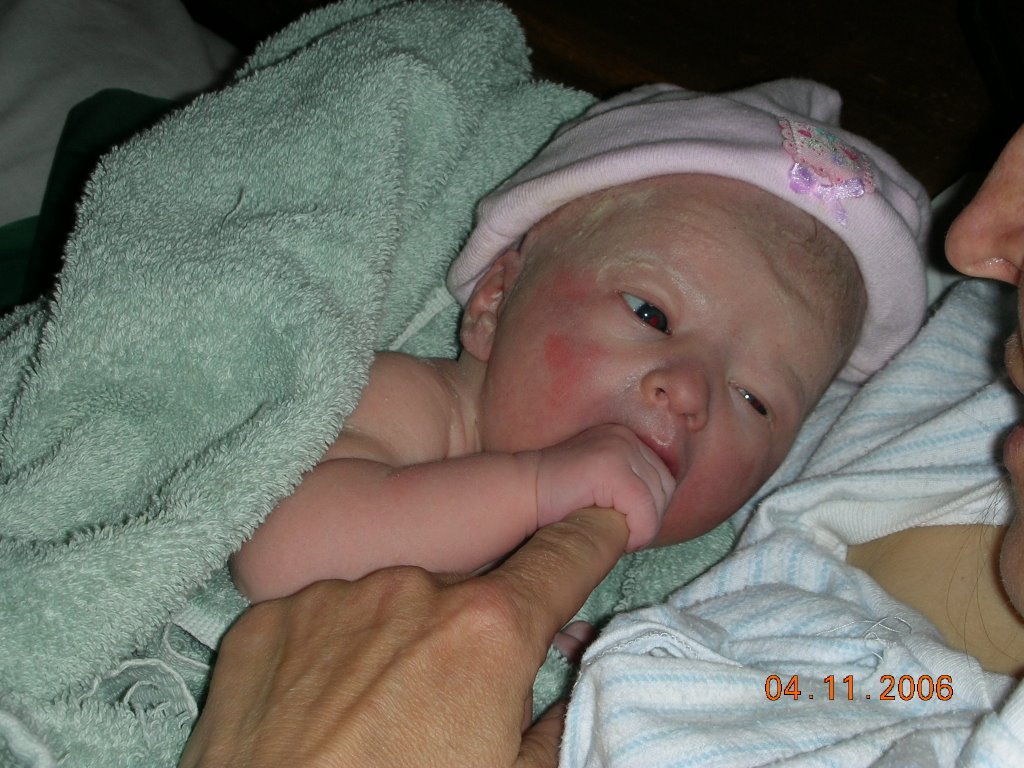
Today's poem is written by the good God, and taken down by two faithful scribes, my dear parents. Her name is Juliana Elizabeth, and she was born this morning at 8:37 a.m. She weighed six pounds and thirteen ounces, and she is nineteen inches long. Mom and baby are both doing well.
Juliana is born into a family of three brothers, 22, 4, and 2 years old, and one sister, me. She is going to get so immensely drowned in pink and lace I don't know what she'll do.
Those of you who drink champagne and smoke cigars, this is the one time I won't make the slightest fuss. Babies are a cause for celebration. As for me, I think I shall eat truffles.
Huzzah for baby Juliana!
Subscribe to:
Posts (Atom)