by Thomas a Kempis
On the Advantage of Not Having Everything Our Own Way
It is good that everything is not always to our liking; for adversity makes people look into their hearts in order to realize that they are exiles and must not put their hopes in any wordly thing.
It is good for us to run into opposition and have others think badly of us, even when our intentions are good. For these things help us to be humble and rid us of pride. Then we seek God more earnestly, Who alone knows our inmost self, when outwardly we are ignored and discredited by others.
2. Therefore, people should rely so entirely on God that they have no need to look for human consolations when adversity comes. When people of good disposition are afflicted or tempted or distracted by evil thoughts, then they understand the need they have of God and that without Him they can do nothing.
Then too they grieve, while they sigh and pray because of the miseries they endure. They grow weary of this life and long for death in order to be with Christ, their Lord. It will also be clear to them that there is neither perfect peace nor security in this world.
* * *
Advent is a good time for a little spiritual reading, and I have been enjoying The Imitation of Christ, which I got in Rome. Thomas a Kempis is a hard teacher, though. He might be better for someone in religious life. He says you should be detached from everything, speak no unnecessary words, avoid spending time with young or foolish people, and so forth, while I think that since my vocation is to be in the world, some of that advice might be a bad idea if I were to follow it. If I did half of what he suggests, I'd be much holier. If I did all of it, I might be Jansenist. Still, I would advise the book because it reminds me of my many shortcomings.
He's certainly spot-on in this chapter. I've often found that the only time I lose something I valued is when it is more important to me than God. It happens again and again: God gives me something, an object, a situation, a task, and I accept it because He gave it to me. Then I love it because it is God's will. Then I love it for itself. Then I start to focus on it and forget the One Who gave it to me. The next thing I know, it's gone because earthly things do go, and God is looking at me and asking, "Why are you so distressed? You didn't lose Me, the one thing you said was most important to you."
And that's when I have to learn that nothing is of any value apart from Him. I guess only adversity can teach me that.
Monday, December 11, 2006

Wednesday, December 06, 2006
On first looking into Chapman's Homer
by John Keats
Much have I travell’d in the realms of gold,
And many goodly states and kingdoms seen;
Round many western islands have I been
Which bards in fealty to Apollo hold.
Oft of one wide expanse had I been told
That deep-brow’d Homer ruled as his demesne;
Yet did I never breathe its pure serene
Till I heard Chapman speak out loud and bold:
Then felt I like some watcher of the skies
When a new planet swims into his ken;
Or like stout Cortez when with eagle eyes
He star’d at the Pacific—and all his men
Look’d at each other with a wild surmise—
Silent, upon a peak in Darien.
* * *
This Petrarchan sonnet shows how important the task of the translator can be. There are so many "realms of gold" quite untravellable to the English speaker without a translation. Furthermore, the translation has to be a good one, like Chapman's seems to have been: "loud and bold." The good translator transmits the tone of the original and not just the facts, so that the reader does not simply know the story, but actually travels in the realm of the story.
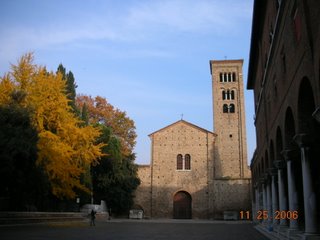
The pictures is of a "realm of gold" I travelled: Ravenna. I had expected a few more echoes of its Byzantine past than I found. Unfortunately, you have to pay to get to see any of the mosaics -- nearly all the churches with Byzantine art cost to get in, and I was too cheap to try it. But there was plenty of gold in the gingko trees, which God never asked payment for.
I also saw Dante's tomb. (Blogger refuses to upload the pictures. I will just have to post them later. Sorry.)
Dante died in Ravenna, exiled from Florence. Once he was dead the Florentines wanted his body, but Ravenna refused, on the reasonable grounds that they hadn't wanted him living, so they certainly weren't going to get the glory from him dead. The fight over his body lasted centuries. Finally the Florentines got the Pope on their side. He ordered Ravenna to surrender the body. Reluctantly, the Ravennese opened the sarcophagus, only to find that Dante wasn't inside! A Ravenna patriot had stolen and hidden the poet's remains. They were finally returned in the 19th century, and have stayed in Ravenna ever since.
Much have I travell’d in the realms of gold,
And many goodly states and kingdoms seen;
Round many western islands have I been
Which bards in fealty to Apollo hold.
Oft of one wide expanse had I been told
That deep-brow’d Homer ruled as his demesne;
Yet did I never breathe its pure serene
Till I heard Chapman speak out loud and bold:
Then felt I like some watcher of the skies
When a new planet swims into his ken;
Or like stout Cortez when with eagle eyes
He star’d at the Pacific—and all his men
Look’d at each other with a wild surmise—
Silent, upon a peak in Darien.
* * *
This Petrarchan sonnet shows how important the task of the translator can be. There are so many "realms of gold" quite untravellable to the English speaker without a translation. Furthermore, the translation has to be a good one, like Chapman's seems to have been: "loud and bold." The good translator transmits the tone of the original and not just the facts, so that the reader does not simply know the story, but actually travels in the realm of the story.
The pictures is of a "realm of gold" I travelled: Ravenna. I had expected a few more echoes of its Byzantine past than I found. Unfortunately, you have to pay to get to see any of the mosaics -- nearly all the churches with Byzantine art cost to get in, and I was too cheap to try it. But there was plenty of gold in the gingko trees, which God never asked payment for.
I also saw Dante's tomb. (Blogger refuses to upload the pictures. I will just have to post them later. Sorry.)
Dante died in Ravenna, exiled from Florence. Once he was dead the Florentines wanted his body, but Ravenna refused, on the reasonable grounds that they hadn't wanted him living, so they certainly weren't going to get the glory from him dead. The fight over his body lasted centuries. Finally the Florentines got the Pope on their side. He ordered Ravenna to surrender the body. Reluctantly, the Ravennese opened the sarcophagus, only to find that Dante wasn't inside! A Ravenna patriot had stolen and hidden the poet's remains. They were finally returned in the 19th century, and have stayed in Ravenna ever since.
Tuesday, December 05, 2006
Links
I've finally had time to browse a bit through the blogsphere. A while ago Meredith wrote a post on triolets which everyone who enjoyed the triolet contest should read. Apparently many people wrote triolets besides Chesterton, I just never came across them myself.
Also, she linked to a fascinating site written in the persona of Chaucer, which, although sometimes quite inappropriate (as Chaucer was in life), is quite funny-bone tickling with its use of Middle English. The review of the recent movie Serpentes on a Shippe made me laugh enough for my mother to hear upstairs.
I'm working on some more posts, but I have to sort through an awful lot of pictures. It seemed at the time that I'd taken a lot, but now I see that a lot of them would only be interesting to me. But don't worry, I'll get some up, and maybe some poems soon too.
Also, she linked to a fascinating site written in the persona of Chaucer, which, although sometimes quite inappropriate (as Chaucer was in life), is quite funny-bone tickling with its use of Middle English. The review of the recent movie Serpentes on a Shippe made me laugh enough for my mother to hear upstairs.
I'm working on some more posts, but I have to sort through an awful lot of pictures. It seemed at the time that I'd taken a lot, but now I see that a lot of them would only be interesting to me. But don't worry, I'll get some up, and maybe some poems soon too.
Sunday, November 26, 2006
Prayers needed
I need to ask all my friends on the blogsphere to pray for a quick intention. Tomorrow we are all supposed to be coming back from Rome. Today my friend had her wallet stolen on a crowded bus, and her passport was in it. The embassy can replace it, but not today, which means she'll have to get her flight changed. That might be difficult to do, because one can't always get an international flight in a hurry. So far things have been difficult. So pray that she gets home safe, sometime soon!
Thank you all, and wish us all a safe trip. Once I'm home I'll get to some serious picture posting.
Thank you all, and wish us all a safe trip. Once I'm home I'll get to some serious picture posting.
Friday, November 17, 2006
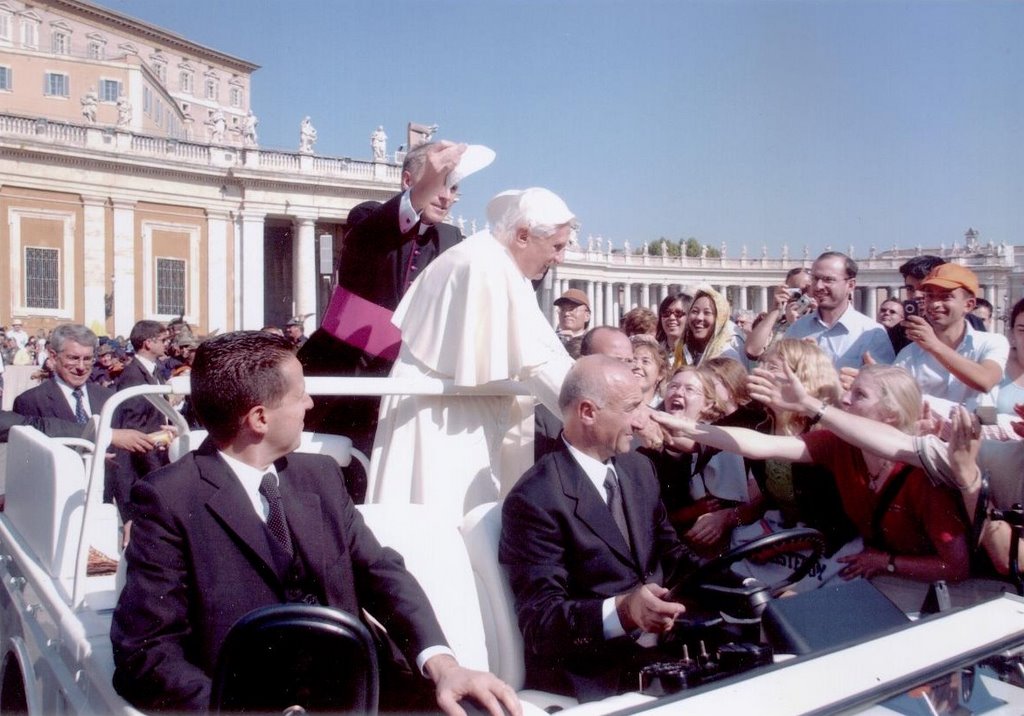
The Pope and I
For all who wanted pictures of what I'm doing . . . here's what I'm doing. Chris's hand is in the way, but that's me anyway! I love B16.

Thursday, November 09, 2006
Pictures of me
In response to popular request:
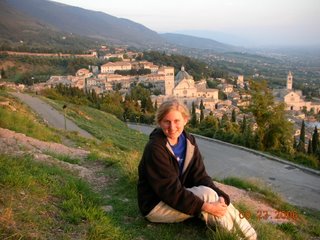
Me by Rocca Maggiore in Assisi.
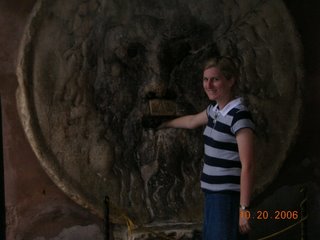
La Bocca della Verità, the Mouth of Truth. You stick your hand in, and if you have an insincere heart the mouth bites it off. I still have two hands!
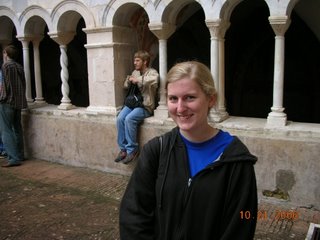
Me at the Benedictine monastery in Subiaco. Matt is in the background.
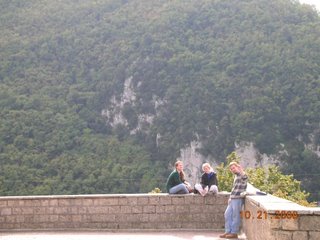
Me with Coriel and Charlemagne in Subiaco. John was there too, but he was holding the camera.
There: happy? That's all I have, for the present.
So long then: I'm going to Ireland this weekend!
Monday, October 09, 2006
The Best Artist
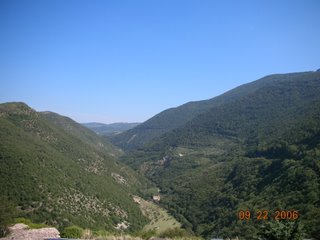
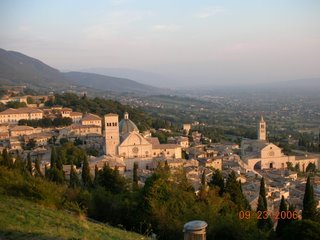
My trip through Assisi, Siena, and Florence convinced me of one thing, if nothing else: while man's art is good, no one can outdo God. So, a lot of nature pictures for you.
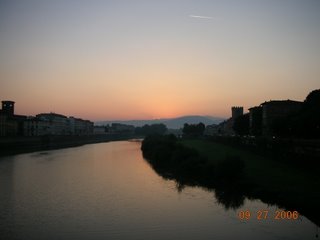

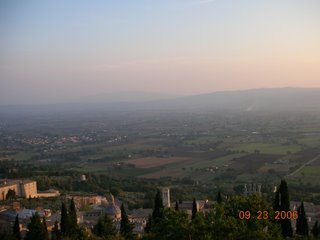
Sunset over the Arno, in Florence.
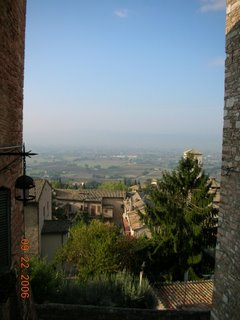
View from Assisi.
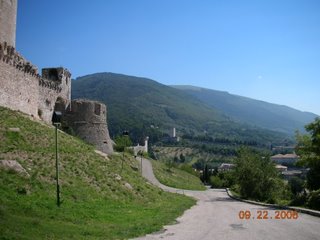

Views from La Rocca, the fortress above Assisi.
Church ceilings
Every time I enter a cathedral, I find myself just wandering around with my head tipped up, staring at the ceiling. These pictures, I think, excuse me.
Ceiling of St. Peter's
Ceiling of the Duomo (S. Maria di Fiori) in Florence


Ceiling of St. Mary Major

Ceiling of S. Prassede

Ceiling of S. Pudenziana
Talk about uplifting the soul to God.
Friday, September 15, 2006
Ciao amici
I meant to bring a whole lot of pictures here to the internet cafe, but left my flash drive back in the hotel. So I'm afraid you'll just have to wait longer yet. I know I've been dilatory lately. Mea culpa, and I firmly intend to blog against soon.
What I've been thinking about most lately is the paradox of this city. Simply put, it is hell: the Metro is a crowded jam of human life without honor or dignity, where gypsy children wander up and down, looking at you pitifully in the hope of a few euros. On the streets, beggars and street vendors vie for your attention, while pickpockets hope to avoid it as they relieve you of your valuables. People push past you without seeing your, or glare at you balefully. A beggar with maimed feet sits propped against the Vatican wall with a picture of the Sacred Heart. Someone speculated that he may have been maimed by his parents in order to help their begging when he was a child. Such things are done here.
Rising up in the midst of the dust, the dirt, the cigarette butts, the urine, the advertising, the loose papers on the street no one reads, is a white stone church. It's barely visible among the buildings around it. But the pillars and statues show years, decades of careful construction. Inside, it's an explosion of colour: white, black, red, blue, gold. Everything is marble, or polished wood. Under the altar is a famous saint you've read about in storybooks, with a Latin inscription above. All is quiet; the holiness is in the air. It is heaven.
Rome is its own Divine Comedy, showing you the best and the worst man can achieve in one. You pass from the streets to the churches and back again. You pass a communist riot to reach St. John Lateran. You read the fascist graffiti all the way to St. Peter's Square. The Romans do the same, passing through the dirty city to whisper their Padre Nostro before the altar of their favorite saint. You wonder if it affects them as it does you. You wonder how they can live in such a contradictory vale of tears.
Probably the same as you have always lived in yours. Rome is just like the rest of the world, after all -- only more so.
What I've been thinking about most lately is the paradox of this city. Simply put, it is hell: the Metro is a crowded jam of human life without honor or dignity, where gypsy children wander up and down, looking at you pitifully in the hope of a few euros. On the streets, beggars and street vendors vie for your attention, while pickpockets hope to avoid it as they relieve you of your valuables. People push past you without seeing your, or glare at you balefully. A beggar with maimed feet sits propped against the Vatican wall with a picture of the Sacred Heart. Someone speculated that he may have been maimed by his parents in order to help their begging when he was a child. Such things are done here.
Rising up in the midst of the dust, the dirt, the cigarette butts, the urine, the advertising, the loose papers on the street no one reads, is a white stone church. It's barely visible among the buildings around it. But the pillars and statues show years, decades of careful construction. Inside, it's an explosion of colour: white, black, red, blue, gold. Everything is marble, or polished wood. Under the altar is a famous saint you've read about in storybooks, with a Latin inscription above. All is quiet; the holiness is in the air. It is heaven.
Rome is its own Divine Comedy, showing you the best and the worst man can achieve in one. You pass from the streets to the churches and back again. You pass a communist riot to reach St. John Lateran. You read the fascist graffiti all the way to St. Peter's Square. The Romans do the same, passing through the dirty city to whisper their Padre Nostro before the altar of their favorite saint. You wonder if it affects them as it does you. You wonder how they can live in such a contradictory vale of tears.
Probably the same as you have always lived in yours. Rome is just like the rest of the world, after all -- only more so.
Sunday, September 03, 2006
Roma!
All right, I have barely any time, but I thought I'd give my faithful readers a few pictures from bella Roma.
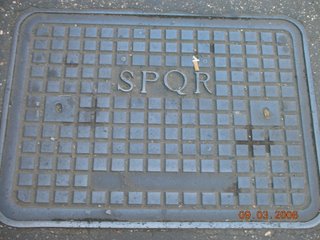
The SPQR manhole covers . . . I love 'em. It stands for Senatus Populusque Romanus, the old motto of the Roman empire. (The Roman Senate and People.)
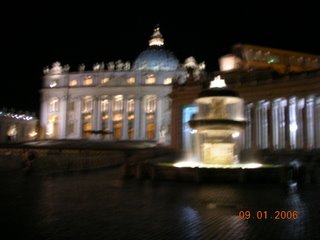
A blurry St. Peter's, on the way back from our classroom.
Mama mia, I'd better go before this internet cafe charges me for another hour. I promise more pictures soon!
Subscribe to:
Posts (Atom)